
Tillerson said China's behaviour and action is "posing a challenge to the rules-based international order".

The United States is moving forward to develop a long-term strategic military partnership with India, a top American military commander said, noting that in the long run, India's role in security in a peaceful Indian Ocean is critical.
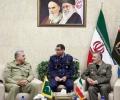
'Tehran senses that the Modi government is inexorably gravitating toward the US-Israeli-Saudi axis, jettisoning India's traditional independent Gulf policies,' notes Ambassador M K Bhadrakumar.
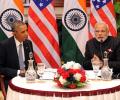
India has moved beyond the traditional trappings of non-alignment
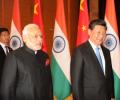
While the two sides' objectives may appear to differ, it is clear that both India and China are emphasising on the common minimum possible areas of cooperation between them, says Srikanth Kondapalli.

Trade enhancement is not about lowering tariff barriers, but dismantling such regulatory barriers.

India and Japan have a shared interest in countervailing China's hegemonic ambitions in Asia. Although neither has an interest in forming an overt anti-China alliance, Tokyo and New Delhi feel increasingly obligated to work together to find ways to guard against a muscular Beijing's power sliding into arrogance, says Brahma Chellaney.

The two sides signed a maritime security agreement after extensive talks between Prime Minister Narendra Modi and his Mauritian counterpart Pravind Jugnauth.

With the Rafale fighter deal stuck over price negotiations, can the prime minister step in and find a way out for both countries?

With Donald Trump the appeal has to be to his business instincts in which his personal interests seem to play a significant role, says former foreign secretary Kanwal Sibal.

Subrahmanyam Jaishankar's worldview sets him apart

We must take action to address the impediments to growth faced by our businesses and our economies. And we can only succeed by working together, says American Secretary of Commerce Penny Pritzker.
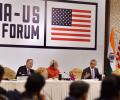
The leaders said trade ties were still fragile

'Lingering border disputes and fierce geostrategic competition in South Asia between China and India are likely to temper any cooperation Beijing might hope to achieve with New Delhi in the SCO,' says P K Vasudeva.
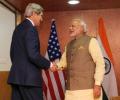
Elaborating on America and India's scope of engagement, Kerry said he has seen first-hand the transformation in Indo-US relationship as well as the ups and downs in the relationship. Kerry says the world's oldest and largest democracy were "finally beginning to captalise on our connections to each other." Sheela Bhatt/Rediff.com reports after the media interaction with the US secretary of state.

Modi is the first foreign leader to be invited to the palace by the Crown Prince, who appreciated the role played by Indian workers in the development of UAE as a modern nation, ministry of external affairs spokesperson Raveesh Kumar tweeted.

The BRICS summit offers Modi an excellent platform to reach out to world leaders and conduct diplomacy on the very ticklish issue of reform of the world governance structure, and to exchange notes with his peers on international, regional and bilateral issues on the margins of the meeting, says Rup Narayan Das.

'Washington is telegraphing here is its willingness to support a low-grade, limited use of force meant to send a strong message to Pakistan.' 'Perhaps something along the lines of the surgical strikes in 2016, or perhaps something a bit more -- but not much more.'

Aziz Haniffa, who has covered every Indian Prime Minister's visit to the US since Rajiv Gandhi in 1985, gives us a peek into what's happening in Washington, DC on the eve of the Modi-Trump summit.

'A bit of marketing, a bit of positioning, and a lot of strategic thinking is required, and all this should be in aid of India's strategic intent: Becoming the third pole in a global G3 and aiming for Numero Uno,' says Rajeev Srinivasan.

'This is the first time that the Americans have agreed to refer to "cross-border terrorist attacks" in a joint statement.' 'No wonder Pakistan has called the joint statement "singularly unhelpful" and has blasted it, and its all-weather friend China has applauded Pakistan's frontline role in combating terrorism,' points out former foreign secretary Ambassador Kanwal Sibal.

"It would be my hope that people understand why this particular transaction is important for us," the EAM said in Washington, DC.
'Only when China treats India as an equal can we consider them real friends.'

'After many rudderless years, India and Japan have prime ministers with a sense of purpose and direction,' says Brahma Chellaney.

President Pranab Mukherjee's visit to Israel is a final and critical step in the normalisation of relations between the two countries.

'The Modi-Xi and Modi-Obama meetings, with an interval of just 12 days, are juxtaposed superbly at a crucial point in the prime minister's life. Can Modi carve out a win-win situation with the superpower and the emerging superpower at the same time?'

Brushing aside India's concerns, China on Monday cemented its "all-weather ties" with Pakistan by agreeing to build a strategic $46 billion (Rs 2.9 lakh crore) economic corridor through Pakistan-occupied Kashmir as part of 51 deals signed, expanding the communist giant's influence in the region.

He said he has always maintained that instead of fighting with each other, India and Pakistan should together fight against poverty.

As the context of Panchsheel has changed, it is all the more essential that India and China need to reinvent and redefine Panchsheel for a new world order taking into account globalisation, and mutual economic interdependence. The new Panchsheel, in order to be relevant, needs to shed its binary approach of west verses the east recognising the seamlessness of global frontiers, which globalisation has brought in, says Rup Narayan Das.

Being a pragmatist Modi is not likely to give preference to China over Japan. Both security and economic aspects are likely to shape Modi's decision in terms of engaging the two biggest economies of Asia, says Sana Hashmi.
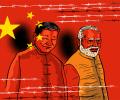
'As China rises and India grows to reclaim their earlier positions on the world stage as two of the largest economies and most important countries, there will indeed be some contention between these two powers.' 'There will also be plenty of space and room for cooperation amongst the two of us.' 'As our economic size increases to match the fact that we are the two most populous nations on earth, it will be all the more important for us to keep the interests of our peoples as well as those of the rest of the world in mind.' 'We shall have to grow together rather than as separate and disparate entities,' points out Ambassador Gautam Bambawale -- who served as India's ambassador to China -- in the 7th annual lecture of the Indian Association of Foreign Affairs Correspondents on March 1, 2019.
We see none of the euphoric build-up customary to India's encounter with US presidents in recent times. This gives Modi wriggle room to work on the much-needed reset of India-US ties.

Modi has debunked the uncontested wisdom of foreign and strategic policy remaining unchanged and running on a broad national consensus. This is clearly seen in his unhesitating embrace of the US and the clear hardening shift in India's stance on Pakistan, says Shekhar Gupta.

India on Friday assured support to its nationals that law-abiding people have nothing to fear after authorities here arrested 31 Indians for alleged rioting in Singapore's worst outbreak of violence in over 40 years.

India on Thursday bluntly told the US that surveillance of political leaders and others in India by the American intelligence was "unacceptable" to which the US responded by saying that any differences that may exist can be resolved by intelligence communities of the two countries.

On the second leg of his trip to Central Asia, Narendra Modi makes quite an impression in Astana, as he talks about terror and trade, films and the future

'Devyani -- she is a public servant and her personal life has already received far too much attention -- and her ambitious father now need to retreat to the background so that wiser diplomatic heads restore sanity to India-US relations as India prepares for parliamentary elections,' says Ambassador K C Singh.

'The diplomat's arrest has led to a major diplomatic spat, the likes of which I have not seen in my nearly three decades of covering the US-India relationship, says Aziz Haniffa. 'The knee-jerk reaction by the powers-that-be in Delhi was myopic to say the least.'

'If there were no Ahmedabad programme -- no flashy town hall event in a huge cricket stadium with thousands cheering him on -- then Trump may well have decided not to go to India.'

In a strong message to China, India and ASEAN on Thursday called for a "full and effective" implementation of the understanding between the parties involved in the South China Sea dispute, while stressing on maritime security and freedom of navigation in the critical sea lanes.
